Description
Feature
● 5–8 Wires Simultaneously — True Parallel Throughput
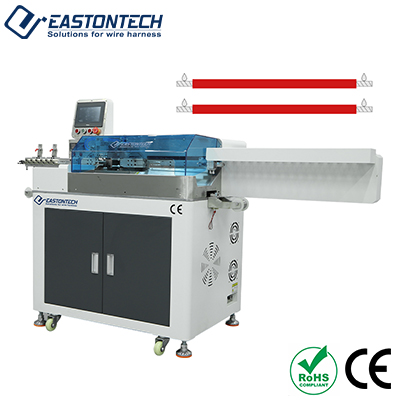
The EW-8015 feeds, cuts, strips, and tins 5 to 8 wires in parallel within a single machine cycle. At 15,000–20,000 pcs/h, this parallel architecture means a 100,000-piece production run completes in 5–7 hours on one machine — compared to 3–5 days on a single-wire tinning machine of comparable individual cycle speed. Standard configuration is 5 wires; up to 8 wires is available on a customised basis.
● Dual-Head Double-End Strip and Tin in One Cycle
Both ends of each wire are stripped and tinned within the same automated cycle — no wire repositioning or second-pass operation is required. This dual-head, double-end processing is the primary reason the EW-8015 achieves 15,000–20,000 pcs/h: each machine cycle produces a fully finished wire assembly on all 5–8 wire channels simultaneously, with no work-in-progress between stripping and tinning steps.
● Consistent Tin Coating Quality Across All Wire Positions
Solder bath temperature, dip depth, and dwell time are all PLC-controlled and uniform across the full 5–8 wire array. This ensures each wire position receives the same tin coating thickness and coverage — preventing the inter-position variation that occurs on manual or semi-automatic tinning benches where dip consistency depends on operator technique and fatigue.
● Optional CCD Inspection and CFM for Quality Traceability
CCD visual inspection verifies strip length, insulation position, and tinning coverage on every cycle. The optional CFM (crimping force monitor) records process parameters for production traceability. Both options are relevant for automotive and EV customers requiring per-cycle quality documentation under IATF 16949 production standards.
Application Range
Consumer electronics multi-wire harness production
Connector harnesses for consumer electronics — USB hubs, motor driver boards, display modules, and sensor assemblies — use 5–8 AWG22–AWG28 wires requiring double-end tinning before board-to-board or wire-to-connector assembly. The EW-8015's parallel processing eliminates the sequential single-wire tinning bottleneck that limits throughput on conventional tinning lines for these high-mix, high-volume products.
Home appliance internal wiring
Appliance motor connections, heating element leads, and control board wiring use 5–8 wire groups in AWG18–AWG22 where double-end tinning provides the PCB soldering and screw terminal connection quality required for appliance reliability standards. The 15,000–20,000 pcs/h throughput matches appliance production line takt times that single-wire tinning machines cannot sustain.
EV and automotive auxiliary wire harness
Auxiliary control and communication wiring in electric vehicles and automotive electronics uses AWG22–AWG16 wire groups where consistent tin coating quality directly affects connector contact resistance and long-term connection reliability. The EW-8015's PLC-controlled uniform dip parameters across all 8 wire positions, combined with optional CCD inspection, meets the quality documentation requirements of automotive Tier 1 wire harness suppliers.